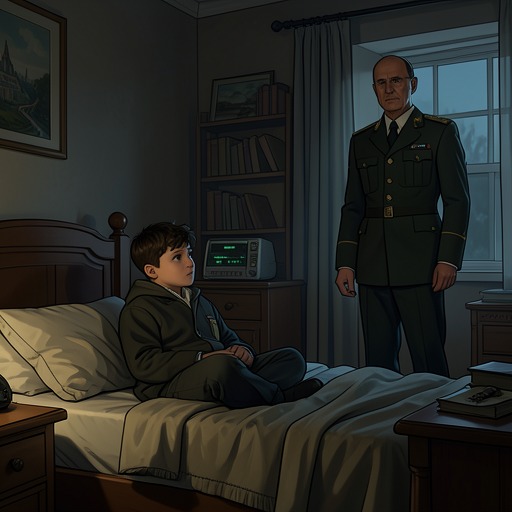
Sanjay Patal
The Passage (Justin Cronin Edition)Sanjay Patal is the head of the Household, a civic leader whose decisions shape the Colony’s response to danger and disputes over authority. He is also Mausami’s father and Gloria’s husband. His public role demands measured judgment; his private life is increasingly unsettled by a recurring dream and, later, by the influence he associates with the Girl from Nowhere. The contrast between his responsibility for maintaining order and his inability to keep his own perceptions intact makes him a point where the Colony’s political crisis and the book’s uncanny forces converge.
Identity and Responsibilities
Sanjay’s work is more consequential than its informal reputation suggests. Household service is sometimes dismissed as not being a real trade, even nicknamed the plumbing committee, but he understands it as a continuous burden: decisions accumulate, and responsibility is never entirely put down. At forty-five, after a sleepless night and a demanding morning, he feels the weight of that office acutely. His authority is practical rather than detached; he must address the Colony’s membership, leadership, security, and disputes while living among the people affected by those choices.
His public manner reflects that responsibility. Watching trainees at their morning drills with Peter, he remarks that they will learn, then turns from the practice grounds to a more difficult matter: the Household seat associated with Peter’s brother. Sanjay believes Peter’s father made an error by passing the seat to the younger brother, because it rightfully belonged to Dana, the oldest Jaxon. The claim shows him treating leadership as a question of proper succession, not simply accepting an arrangement because it is already in place. He raises it directly with Peter, who is tired but accepts that the duty falls to him.
Family and Political Judgment
Sanjay’s convictions about order coexist with deep attachment to his family. He remembers Mausami’s birth as a crisis in which he feared both Gloria and the child might die. After earlier miscarriages and false alarms, the pregnancy was difficult, and the labor lasted two days. Prudence brought him the swaddled newborn while he sat overwhelmed by the wait; at first, he could scarcely understand that the child was alive. Seeing Mausami’s face brought him, for the first and only time in his life, the feeling he recognized as love. His later protective decisions are therefore grounded in a formative, intensely personal bond, not merely in the calculations of a Household official.
That attachment can make his political judgment restrictive. Sanjay wants Mausami away from Theo and off the Watch, a choice connected to his concern about relationships and what those relationships might mean amid the Colony’s dangers. He has been thinking about who is allied with whom, and about the secrets people share. His anxiety becomes more pointed when he considers how widely accounts of strange dreams may have spread: he has urged Mimi to keep her own experience secret, yet suspects that others, including Theo, may know something. He expects conflict over the guns to be a matter not of whether they will be drawn but when, and under what circumstances. His attention to personal loyalties reveals how closely the Household’s politics are bound to intimate ties.
Authority During the Colony’s Crisis
Sanjay’s decisions are tested when the Colony responds to the girl’s arrival with suspicion. He arrests Caleb for opening the gate, insisting that Caleb knows the law. The action establishes Sanjay as an enforcer of the rules at a moment when residents are frightened and looking for someone to blame. When Peter is questioned about his friendship with Alicia, Sanjay asks whether she has indicated that she knows the girl or has seen her before. The inquiry is part of a broader attempt to determine what people know, but it also places Peter’s private relationships under institutional scrutiny.
After the attack, Sanjay communicates a series of consequences to Peter and the others. He says Caleb bears the blame and that Soo Ramirez, who was out of position, has offered to resign as First Captain; the Household has reluctantly accepted. Jimmy will take the post, while Hollis is removed from the Wall until he is ready to return. Alicia is ordered to stand down from the Watch and reassigned to Heavy Duty. The decisions distribute responsibility across the Colony’s security structure, though they also show how quickly a crisis can alter people’s positions and duties.
Sanjay’s measured approach cannot prevent fear from becoming public accusation. When Sam Chou claims that the girl is responsible for eleven deaths and calls for her and Caleb to be put out, Sanjay is among the voices challenged by the crowd’s anger. The call is taken up in an echoing chorus, and Peter sees the gathering poised on the edge of violence as the appearance of order falls away. The episode exposes the limit of Sanjay’s authority: rules and official decisions cannot by themselves settle the fear that residents have attached to the newcomer.
Dreams and the Voice of Babcock
Sanjay’s private disorientation predates the girl’s arrival. Since childhood in the Sanctuary, he has dreamed of the Time Before: a woman in a kitchen, a telephone, and a voice that sings a name. The dream has the texture of a vision rather than an ordinary memory; even the obsolete telephone seems to supply knowledge from a world he has never lived in. The voice identifies itself as Babcock, and Sanjay experiences it as something within him, almost another person or soul sharing his existence. The repeated declaration, “I am Babcock. We are Babcock,” turns a solitary dream into an unsettling suggestion of shared identity.
When the Girl from Nowhere appears, Sanjay is certain, or nearly certain, that he has never dreamed of her. Her presence therefore seems to refute what he knows of himself: she is a being of flesh and blood whom he cannot locate either in his conscious identity or in the secret part of him associated with dreams. Yet his awareness of Babcock and of other people’s possible experiences makes the girl’s arrival difficult to keep separate from the older mystery. He suspects that the dreams may be known to others, and the prospect of shared knowledge feeds his fear of hidden alliances and impending conflict.
Breakdown and Narrative Significance
After the Colony’s violence and deaths, Sanjay cannot sleep. He feels that the girl has somehow entered his mind, where she is associated with Babcock and the Many. His thoughts no longer feel fully his own: he experiences himself as both inside and outside his perspective, as Sanjay and not Sanjay. The disturbance does not remain an abstract fear. In the night, he rises and calls for Jimmy, only for Gloria to remind him that Jimmy is dead. He then names a succession of the dead, including Old Chou, Walter Fisher, Soo Ramirez, the Colonel, Theo, Gloria, Mausami, and himself, and concludes that the world around him is a dream in which the girl is the dreamer.
This collapse reverses Sanjay’s earlier role. The man who tries to settle disputes, enforce law, and anticipate the consequences of allegiance becomes unable to distinguish the ordinary world from the terrifying explanation taking shape in his mind. His final certainty is not presented as a reliable account of events; it is the endpoint of a breakdown in which grief, prior dreams, and the girl’s perceived influence have fused. Through Sanjay, the novel sets civic order against the fragility of individual perception: the Household can assign posts and impose rules, but neither its procedures nor his own disciplined reasoning can contain the force of what he experiences.